
- Home
- Terry Pratchett
Discworld 05 - Sourcery Page 3
Discworld 05 - Sourcery Read online
Page 3
“I mean, how did they all get started? I mean, back in the old times, there were real wizards, there was none of this levels business. They just went out and—did it. Pow!”
One or two of the other customers in the darkened bar of the Mended Drum tavern looked around hastily at the noise. They were new in town. Regular customers never took any notice of surprising noises like groans or unpleasantly gristly sounds. It was a lot healthier. In some parts of the city curiosity didn’t just kill the cat, it threw it in the river with lead weights tied to its feet.
Rincewind’s hands weaved unsteadily over the array of empty glasses on the table in front of him. He’d almost been able to forget about the cockroaches. After another drink he might manage to forget about the mattress, too.
“Whee! A fireball! Fizz! Vanishing like smoke! Whee!—Sorry.”
The Librarian carefully pulled what remained of his beer out of the reach of Rincewind’s flailing arms.
“Proper magic.” Rincewind stifled a belch.
“Oook.”
Rincewind stared into the frothy remnants of his last beer, and then, with extreme care in case the top of his head fell off, leaned down and poured some into a saucer for the Luggage. It was lurking under the table, which was a relief. It usually embarrassed him in bars by sidling up to drinkers and terrorizing them into feeding it potato chips.
He wondered fuzzily where his train of thought had been derailed.
“Where was I?”
“Oook,” the Librarian hinted.
“Yeah.” Rincewind brightened. “They didn’t have all this levels and grades business, you know. They had sourcerers in those days. They went out in the world and found new spells and had adventures—”
He dipped a finger in a puddle of beer and doodled a design on the stained, scratched timber of the table.
One of Rincewind’s tutors had said of him that “to call his understanding of magical theory abysmal is to leave no suitable word to describe his grasp of its practice.” This had always puzzled him. He objected to the fact that you had to be good at magic to be a wizard. He knew he was a wizard, deep in his head. Being good at magic didn’t have anything to do with it. That was just an extra, it didn’t actually define somebody.
“When I was a little boy,” he said wistfully, “I saw this picture of a sourcerer in a book. He was standing on a mountain top waving his arms and the waves were coming right up, you know, like they do down in Ankh Bay in a gale, and there were flashes of lightning all around him—”
“Oook?”
“I don’t know why they didn’t, perhaps he had rubber boots on,” Rincewind snapped, and went on dreamily, “And he had this staff and a hat on, just like mine, and his eyes were sort of glowing and there was all this sort of like glitter coming out of his fingertips, and I thought one day I’ll do that, and—”
“Oook?”
“Just a half, then.”
“Oook.”
“How do you pay for this stuff? Every time anyone gives you any money you eat it.”
“Oook.”
“Amazing.”
Rincewind completed his sketch in the beer. There was a stick figure on a cliff. It didn’t look much like him—drawing in stale beer is not a precise art—but it was meant to.
“That’s what I wanted to be,” he said. “Pow! Not all this messing around. All this books and stuff, that isn’t what it should all be about. What we need is real wizardry.”
That last remark would have earned the prize for the day’s most erroneous statement if Rincewind hadn’t then said:
“It’s a pity there aren’t any of them around anymore.”
Spelter rapped on the table with his spoon.
He was an impressive figure, in his ceremonial robe with the purple-and-vermine* hood of the Venerable Council of Seers and the yellow sash of a fifth level wizard; he’d been fifth level for three years, waiting for one of the sixty-four sixth level wizards to create a vacancy by dropping dead. He was in an amiable mood, however. Not only had he just finished a good dinner, he also had in his quarters a small vial of a guaranteed untastable poison which, used correctly, should guarantee him promotion within a few months. Life looked good.
The big clock at the end of the hall trembled on the verge of nine o’clock.
The tattoo with the spoon hadn’t had much effect. Spelter picked up a pewter tankard and brought it down hard.
“Brothers!” he shouted, and nodded as the hubbub died away. “Thank you. Be upstanding, please, for the ceremony of the, um, keys.”
There was a ripple of laughter and a general buzz of expectancy as the wizards pushed back their benches and got unsteadily to their feet.
The double doors to the hall were locked and triple barred. An incoming Archchancellor had to request entry three times before they would be unlocked, signifying that he was appointed with the consent of wizardry in general. Or some such thing. The origins were lost in the depths of time, which was as good a reason as any for retaining the custom.
The conversation died away. The assembled wizardry stared at the doors.
There was a soft knocking.
“Go away!” shouted the wizards, some of them collapsing at the sheer subtlety of the humor.
Spelter picked up the great iron ring that contained the keys to the University. They weren’t all metal. They weren’t all visible. Some of them looked very strange indeed.
“Who is that who knocketh without?” he intoned.
“I do.”
What was strange about the voice was this: it seemed to every wizard that the speaker was standing right behind him. Most of them found themselves looking over their shoulders.
In that moment of shocked silence there was the sharp little snick of the lock. They watched in fascinated horror as the iron bolts traveled back of their own accord; the great oak beams of timber, turned by Time into something tougher than rock, slid out of their sockets; the hinges flared from red through yellow to white and then exploded. Slowly, with a terrible inevitability, the doors fell into the hall.
There was an indistinct figure standing in the smoke from the burning hinges.
“Bloody hell, Virrid,” said one of the wizards nearby, “that was a good one.”
As the figure strode into the light they could all see that it was not, after all, Virrid Wayzygoose.
He was at least a head shorter than any other wizard, and wore a simple white robe. He was also several decades younger; he looked about ten years old, and in one hand he held a staff considerably taller than he was.
“Here, he’s no wizard—”
“Where’s his hood, then?”
“Where’s his hat?”
The stranger walked up the line of astonished wizards until he was standing in front of the top table. Spelter looked down at a thin young face framed by a mass of blond hair, and most of all he looked into two golden eyes that glowed from within. But he felt they weren’t looking at him. They seemed to be looking at a point six inches beyond the back of his head. Spelter got the impression that he was in the way, and considerably surplus to immediate requirements.
He rallied his dignity and pulled himself up to his full height.
“What is the meaning of, um, this?” he said. It was pretty weak, he had to admit, but the steadiness of that incandescent glare appeared to be stripping all the words out of his memory.
“I have come,” said the stranger.
“Come? Come for what?”
“To take my place. Where is the seat for me?”
“Are you a student?” demanded Spelter, white with anger. “What is your name, young man?”
The boy ignored him and looked around at the assembled wizards.
“Who is the most powerful wizard here?” he said. “I wish to meet him.”
Spelter nodded his head. Two of the college porters, who had been sidling toward the newcomer for the last few minutes, appeared at either elbow.
“Take him out and throw him i
n the street,” said Spelter. The porters, big solid serious men, nodded. They gripped the boy’s pipestem arms with hands like banana bunches.
“Your father will hear of this,” said Spelter severely.
“He already has,” said the boy. He glanced up at the two men and shrugged.
“What’s going on here?”
Spelter turned to see Skarmer Billias, head of the Order of the Silver Star. Whereas Spelter tended toward the wiry, Billias was expansive, looking rather like a small captive balloon that had for some reason been draped in blue velvet and vermine; between them, the wizards averaged out as two normal-sized men.
Unfortunately, Billias was the type of person who prided himself on being good with children. He bent down as far as his dinner would allow and thrust a whiskery red face toward the boy.
“What’s the matter, lad?” he said.
“This child had forced his way into here because, he says, he wants to meet a powerful wizard,” said Spelter, disapprovingly. Spelter disliked children intensely, which was perhaps why they found him so fascinating. At the moment he was successfully preventing himself from wondering about the door.
“Nothing wrong with that,” said Billias. “Any lad worth his salt wants to be a wizard. I wanted to be a wizard when I was a lad. Isn’t that right lad?”
“Are you puissant?” said the boy.
“Hmm?”
“I said, are you puissant? How powerful are you?”
“Powerful?” said Billias. He stood up, fingered his eighth-level sash, and winked at Spelter. “Oh, pretty powerful. Quite powerful as wizards go.”
“Good. I challenge you. Show me your strongest magic. And when I have beaten you, why, then I shall be Archchancellor.”
“Why, you impudent—” began Spelter, but his protest was lost in the roar of laughter from the rest of the wizards. Billias slapped his knees, or as near to them as he could reach.
“A duel, eh?” he said. “Pretty good, eh?”
“Duelling is forbidden, as well you know,” said Spelter. “Anyway, it’s totally ridiculous! I don’t know who did the doors for him, but I will not stand here and see you waste all our time—”
“Now, now,” said Billias. “What’s your name, lad?”
“Coin.”
“Coin sir,” snapped Spelter.
“Well, now, Coin,” said Billias. “You want to see the best I can do, eh?”
“Yes.”
“Yes sir,” snapped Spelter. Coin gave him an unblinking stare, a stare as old as time, the kind of stare that basks on rocks on volcanic islands and never gets tired. Spelter felt his mouth go dry.
Billias held out his hands for silence. Then, with a theatrical flourish, he rolled up the sleeve of his left arm and extended his hand.
The assembled wizards watched with interest. Eighth-levels were above magic, as a rule, spending most of their time in contemplation—normally of the next menu—and, of course, avoiding the attentions of ambitious wizards of the seventh-level. This should be worth seeing.
Billias grinned at the boy, who returned it with a stare that focused on a point a few inches beyond the back of the old wizard’s head.
Somewhat disconcerted, Billias flexed his fingers. Suddenly this wasn’t quite the game he had intended, and he felt an overpowering urge to impress. It was swiftly overtaken by a surge of annoyance at his own stupidity in being unnerved.
“I shall show you,” he said, and took a deep breath, “Maligree’s Wonderful Garden.”
There was a susurration from the diners. Only four wizards in the entire history of the University had ever succeeded in achieving the complete Garden. Most wizards could create the trees and flowers, and a few had managed the birds. It wasn’t the most powerful spell, it couldn’t move mountains, but achieving the fine detail built into Maligree’s complex syllables took a finely tuned skill.
“You will observe,” Billias added, “nothing up my sleeve.”
His lips began to move. His hands flickered through the air. A pool of golden sparks sizzled in the palm of his hand, curved up, formed a faint sphere, began to fill in the detail…
Legend had it that Maligree, one of the last of the true sourcerers, created the Garden as a small, timeless, private self-locking universe where he could have a quiet smoke and a bit of a think while avoiding the cares of the world. Which was itself a puzzle, because no wizard could possibly understand how any being as powerful as a sourcerer could have a care in the world. Whatever the reason, Maligree retreated further and further into a world of his own and then, one day, closed the entrance after him.
The garden was a glittering ball in Billias’s hands. The nearest wizards craned admiringly over his shoulders, and looked down into a two-foot sphere that showed a delicate, flower-strewn landscape; there was a lake in the middle distance, complete in every ripple, and purple mountains behind an interesting-looking forest. Tiny birds the size of bees flew from tree to tree, and a couple of deer no larger than mice glanced up from their grazing and stared out at Coin.
Who said critically: “It’s quite good. Give it to me.”
He took the intangible globe out of the wizard’s hands and held it up.
“Why isn’t it bigger?” he said.
Billias mopped his brow with a lace-edged handkerchief.
“Well,” he said weakly, so stunned by Coin’s tone that he was quite unable to be affronted, “since the old days, the efficacity of the spell has rather—”
Coin stood with his head on one side for a moment, as though listening to something. Then he whispered a few syllables and stroked the surface of the sphere.
It expanded. One moment it was a toy in the boy’s hands, and the next…
…the wizards were standing on cool grass, in a shady meadow rolling down to the lake. There was a gentle breeze blowing from the mountains; it was scented with thyme and hay. The sky was deep blue shading to purple at the zenith.
The deer watched the newcomers suspiciously from their grazing ground under the trees.
Spelter looked down in shock. A peacock was pecking at his bootlaces.
“—” he began, and stopped. Coin was still holding a sphere, a sphere of air. Inside it, distorted as though seen through a fish-eye lens or the bottom of a bottle, was the Great Hall of Unseen University.
The boy looked around at the trees, squinted thoughtfully at the distant, snow-capped mountains, and nodded at the astonished men.
“It’s not bad,” he said. “I should like to come here again.” He moved his hands in a complicated motion that seemed, in some unexplained way, to turn them inside out.
Now the wizards were back in the hall, and the boy was holding the shrinking Garden in his palm. In the heavy, shocked silence he put it back into Billias’s hands, and said: “That was quite interesting. Now I will do some magic.”
He raised his hands, stared at Billias, and vanished him.
Pandemonium broke out, as it tends to on these occasions. In the center of it stood Coin, totally composed, in a spreading cloud of greasy smoke.
Ignoring the tumult, Spelter bent down slowly and, with extreme care, picked a peacock feather off the floor. He rubbed it thoughtfully back and forth across his lips as he looked from the doorway to the boy to the vacant Archchancellor’s chair, and his thin mouth narrowed, and he began to smile.
An hour later, as thunder began to roll in the clear skies above the city, and Rincewind was beginning to sing gently and forget all about cockroaches, and a lone mattress was wandering the streets, Spelter shut the door of the Archchancellor’s study and turned to face his fellow mages.
There were six of them, and they were very worried.
They were so worried, Spelter noted, that they were listening to him, a mere fifth level wizard.
“He’s gone to bed,” he said, “with a hot milk drink.”
“Milk?” said one of the wizards, with tired horror in his voice.
“He’s too young for alcohol,” explain
ed the bursar.
“Oh, yes. Silly of me.”
The hollow-eyed wizard opposite said: “Did you see what he did to the door?”
“I know what he did to Billias!”
“What did he do?”
“I don’t want to know!”
“Brothers, brothers,” said Spelter soothingly. He looked down at their worried faces and thought: too many dinners. Too many afternoons waiting for the servants to bring in the tea. Too much time spent in stuffy rooms reading old books written by dead men. Too much gold brocade and ridiculous ceremony. Too much fat. The whole University is ripe for one good push…
Or one good pull…
“I wonder if we really have, um, a problem here,” he said.
Gravie Derment of the Sages of the Unknown Shadow hit the table with his fist.
“Good grief, man!” he snapped. “Some child wanders in out of the night, beats two of the University’s finest, sits down in the Archchancellor’s chair and you wonder if we have a problem? The boy’s a natural! From what we’ve seen tonight, there isn’t a wizard on the Disc who could stand against him!”
“Why should we stand against him?” said Spelter, in a reasonable tone of voice.
“Because he’s more powerful than we are!”
“Yes?” Spelter’s voice would have made a sheet of glass look like a plowed field, it made honey look like gravel.
“It stands to reason—”
Gravie hesitated. Spelter gave him an encouraging smile.
“Ahem.”
The ahemmer was Marmaric Carding, head of the Hoodwinkers. He steepled his beringed fingers and peered sharply at Spelter over the top of them. The bursar disliked him intensely. He had considerable doubt about the man’s intelligence. He suspected it might be quite high, and that behind those vein-crazed jowls was a mind full of brightly polished little wheels, spinning like mad.
“He does not seem overly inclined to use that power,” said Carding.
“What about Billias and Virrid?”
“Childish pique,” said Carding.
The other wizards stared from him to the bursar. They were aware of something going on, and couldn’t quite put their finger on it.
The reason that wizards didn’t rule the Disc was quite simple. Hand any two wizards a piece of rope and they would instinctively pull in opposite directions. Something about their genetics or their training left them with an attitude toward mutual co-operation that made an old bull elephant with terminal toothache look like a worker ant.
 Feet of Clay
 The Color of Magic
 Thud!
Thud! Good Omens: The Nice and Accurate Prophecies of Agnes Nutter, Witch
 I Shall Wear Midnight
 Mort
Mort Raising Steam
 Guards! Guards!
 Equal Rites
 A Hat Full of Sky
 The Light Fantastic
 Mrs Bradshaw's Handbook
 Wyrd Sisters
 Soul Music
 Small Gods
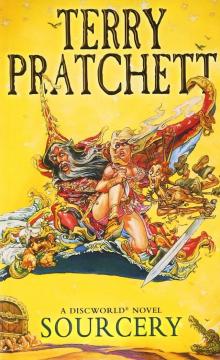 Sourcery
 Reaper Man
 Night Watch
 Lords and Ladies
 The Fifth Elephant
 Monstrous Regiment
 The Truth
 Witches Abroad
 Eric
Eric Going Postal
 Men at Arms
 Jingo
Jingo The Amazing Maurice and His Educated Rodents
 The Wee Free Men
 Pyramids
 Wintersmith
 Moving Pictures
 Carpe Jugulum
 Interesting Times
 Maskerade
 Making Money
 The Shepherd's Crown
 Hogfather
 Troll Bridge
 The Last Continent
 The Sea and Little Fishes
 Snuff
Snuff Unseen Academicals
 Guards! Guards! tds-8
 Jingo d-21
 Turtle Recall: The Discworld Companion ... So Far
 The Fifth Elephant d-24
 Discworld 39 - Snuff
 The Long War
 Only You Can Save Mankind
 The Science of Discworld III - Darwin's Watch tsod-3
 A Blink of the Screen: Collected Short Fiction
 Unseen Academicals d-37
 Wings
Wings Making Money d-36
 A Blink of the Screen
 Johnny and the Bomb
 Dodger
 Strata
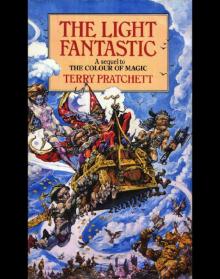 Discworld 02 - The Light Fantastic
 The Folklore of Discworld
 The Science of Discworld
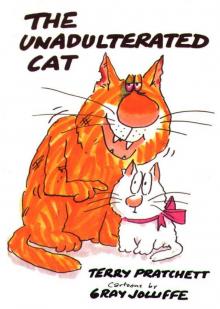 The Unadulterated Cat
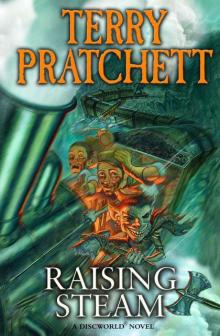 Raising Steam: (Discworld novel 40) (Discworld Novels)
 The World of Poo
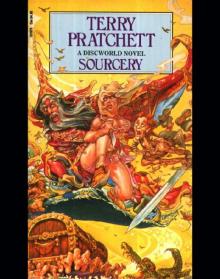 Discworld 05 - Sourcery
 The Witch's Vacuum Cleaner: And Other Stories
 The Science of Discworld II - The Globe tsod-2
 Small Gods: Discworld Novel, A
 Men at Arms tds-15
 Tama Princes of Mercury
 The Last Hero (the discworld series)
 The Long Utopia
 Discworld 03 - Equal Rites
 Terry Pratchett - The Science of Discworld
 The Long Earth
 The Carpet People
 The Sea and Little Fishes (discworld)
 The Colour of Magic
 Discworld 16 - Soul Music
 The Long Cosmos
 The Dark Side of the Sun
 Monstrous Regiment tds-28
 The Bromeliad 3 - Wings
 Dragons at Crumbling Castle: And Other Stories
 Night Watch tds-27
 The Science of Discworld I tsod-1
 The Bromeliad 1 - Truckers
 The Science of Discworld Revised Edition
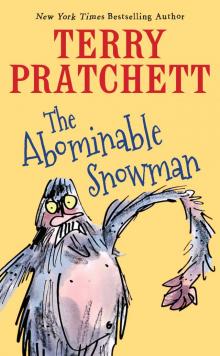 The Abominable Snowman
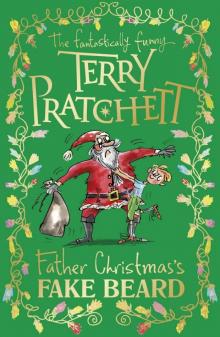 Father Christmas’s Fake Beard
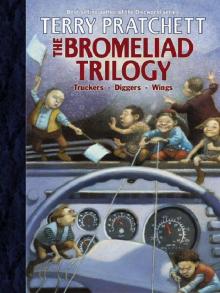 The Bromeliad Trilogy
 A Slip of the Keyboard
 The Wee Free Men d(-2
 Johnny and the Dead
 Mrs Bradshaw's Handbook (Discworld Novels)
 Truckers
 The Amazing Maurice and His Educated Rodents d(-1
 Diggers
 Thief of Time tds-26
 Science of Discworld III
 Dragons at Crumbling Castle
 Nation
 Darwin's Watch
 Interesting Times d-17
 The Bromeliad 2 - Diggers
 The Science of Discworld II